.png)
Compliance is not a report. It is how the operation runs.
Axxion's governance model is not a layer added on top of claims processing. It is the claims processing. Every decision is documented at the point it is made. Every cost is benchmarked before it is approved. Every handoff is logged with identity, timestamp, and evidence. The result is an operation that produces compliance as a by-product of doing the work, not as a quarterly documentation exercise.
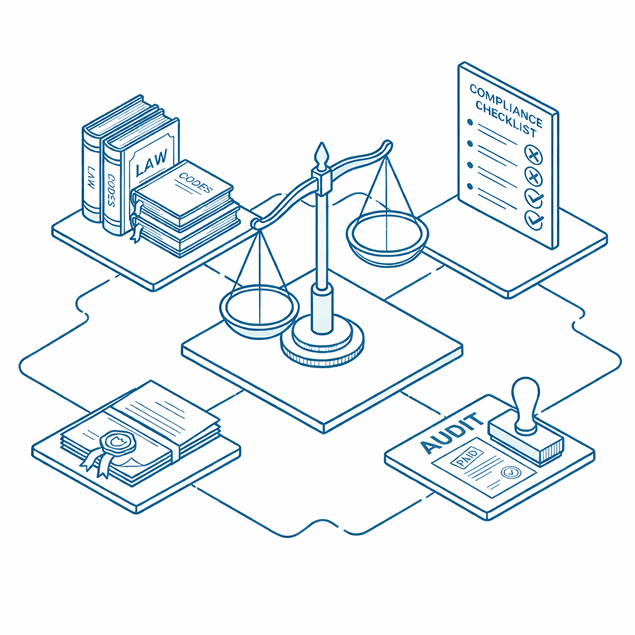
Three governance layers, one integrated system
Axxion's governance operates on three layers that reinforce each other. The compliance gates govern the claim lifecycle — seven checkpoints that enforce documentation, data registration, and approval before a claim can advance. The cost gates govern the repair — four control points that verify pricing, prevent inflation, and eliminate undisclosed markups. The security layer governs the infrastructure — access controls, data residency, audit logging, and incident management.
The three layers are not independent. The compliance gates feed data into the cost gates (a claim cannot reach estimate approval without passing registration completeness). The cost gates feed data into the security layer (every pricing decision is logged with user attribution and timestamp). And the security layer enforces the access rules that prevent any single user from circumventing the gates. The system is designed so that the only way to process a claim is the governed way.

Seven compliance gates govern every claim from registration to settlement
No claim advances without passing the gate in front of it. Each gate enforces specific documentation, validation, and approval requirements before the claim can progress. The gates are system-enforced — not policy documents that depend on individual compliance. A claim that fails a gate stops until the deficiency is resolved.
I
Registration completeness
All documents and fraud screening verified before triage.
All mandatory documents received and validated: Emirates ID, Mulkiya, license, and police report. Policy confirmed active. Police report consistent with reported incident. Duplicate claim check completed. Initial fraud screening completed. Vehicle history verified including non-GCC flag. Every step timestamped.
II
Triage validation
Damage classified, repair path assigned, and reserve set.
Damage classified as standard, complex, or total loss. Repair path assigned and fully documented. Vehicle movability assessed and recovery coordinated if required. Initial reserve set and sent to insurer. All fraud indicators from intake reviewed — cleared or escalated. Any AI override rationale recorded.
III
Allocation governance
Workshop selected with full scoring logged and overrides documented.
Workshop selected via weighted algorithm scoring price, proximity, capability, damage match, and policy rules. Full scoring logged for every evaluated workshop. Any override of the algorithm's recommendation documented with reason. Insurer network restrictions enforced automatically. Conflict-of-interest prevention built into allocation logic.
IV
Estimate approval
Benchmarking,
documented repair methods, LPO.
Estimate reviewed by Axxion surveyor against benchmark data. Variance thresholds enforced per insurer rules. Repair method decisions documented with rationale: repair vs. replace, OEM vs. aftermarket. LPO issued formally. Supplements require photographic evidence, benchmark review, and a revised LPO before additional work proceeds.
V
Quality
release
Two-layer QC audit completed before
release.
Workshop internal QC form completed with photographs. Axxion independent audit completed — remote or on-site. All deficiencies resolved and re-inspected before release. Quality result linked to workshop performance profile. The system blocks claim advancement to hand-back without a completed QC record.
VI
Hand-back completion
Acceptance signed, vehicle delivered, post-repair closed.
Policyholder acceptance signed and police report returned. Full cost breakdown and audit trail packaged for insurer. All mandatory milestone communications verified via system log — no gaps in the notification record. Customer satisfaction survey dispatched immediately. Any dissatisfaction triggers immediate escalation protocol.
VII
Settlement validation
Invoice matched, audit trail verified, recovery claims formatted.
Workshop invoice validated against approved estimate and LPO. Any variance documented with justification. All supporting documentation complete and linked. Audit trail from FNOL through settlement verified as unbroken. Recovery claims formatted per CBUAE inter-insurer settlement platform requirements before submission.
Four cost gates catch inflation, leakage, and markup before payment
Axxion's 4-gate defense mechanism enforces compliance and cost containment at every stage of the repair. No gate can be crossed without proper documentation. The gates operate within the compliance framework above — a claim must pass its compliance gate before reaching the corresponding cost gate.
Gate
Eligibility and fraud — claims intake / FNOL
Stop non-payable claims. The claim is verified as payable before the vehicle moves or a repairer is engaged.
What this gate catches:
Coverage and exclusions: non-covered events, partial cover, deductible implications, policy conditions, endorsements, exclusions.
Eligibility gaps: expired policy, wrong driver, missing documents, non-matching details.
Fraud red flags: inconsistent accident narrative, document anomalies, repeated claimant/vehicle patterns, suspicious timing, staged-loss indicators.
Gate
Triage protocol — pre-estimate routing
Best-fit, not nearest garage. Control where the car goes before it moves, based on car and damage.
What this gate catches:
Misrouted repairs: drivable + minor damage not sent to quick repair partners, unnecessary agency referrals.
Network inefficiency: underperforming workshops, poor cycle times, above-benchmark costs, no capacity-aware assignment.
Specialist mismatches: EV/ADAS/structural work sent to uncertified repairers, high-value vehicles in low-capability shops, warranty-sensitive repairs.
Gate
Intervention — estimate control
No inflation, no games. Audit and challenge every estimate before authorization.
What this gate catches:
Labor inflation: excessive hours, duplicated operations, non-standard repair methods, uncapped paint and material charges.
Replace-over-repair bias: parts replaced when repairable, unnecessary strip-downs, inflated panel counts, unjustified add-ons.
Supplement abuse: repeat top-ups without evidence, scope creep after approval, missing documentation, noncompliant repair-vs.-replace decisions.
Gate
Supply — parts control
No markup, no padding. Parts sourcing is governed so the workshop cannot inflate pricing.
What this gate catches:
Price leakage: unapproved or undisclosed supplier markups, inflated parts pricing, no benchmarking against market rates.
Sourcing non-compliance: OEM parts used where approved alternatives exist, bypassed preferred suppliers, unauthorized parts substitutions.
Billing irregularities: duplicate parts charges, unused parts not returned, phantom line items, parts invoiced but not fitted to vehicle.

The gap between the best and worst motor claims operations in the UAE is enormous — not because the talent isn't there, but because the processes aren't standardized. Loss ratios are shaped as much by operational discipline as by underwriting.

Built for the New CBUAE Law not retrofitted to it
The CBUAE's regulatory framework — Federal Decree-Law No. 6/2025 (which replaced Decree-Law 48/2023 in September 2025), CBUAE Circulars 24/2022 and 25/2022, and the CBUAE Rulebook — raises the standard for claims governance, documentation, data trails, and operational controls. The compliance framework requires execution-based compliance: controls embedded in systems, not documented in binders.
Axxion's claims pipeline was designed around these requirements from the start. The table below maps seven core regulatory obligations to how they are handled in the current industry and how Axxion's Claims OS addresses them.
audit trails
AI assists. Humans decide.
AI runs through every stage of Axxion's claims pipeline: damage classification, fraud screening, estimate validation, workshop routing, and customer communications. Every AI function operates under strict governance: no AI agent makes a binding decision without human review, and every AI recommendation that is overridden is logged with the reason.
The table below shows where AI operates, what it does, and where the human stays in the loop.


Controls that can be evidenced
Axxion operates under the same governance standards it applies to the claims it manages. Data handling, access controls, and operational security are built into the platform architecture, not managed through policies alone.
I
Data handling and residency
All claims data is processed and stored within compliant infrastructure. Data residency, encryption at rest and in transit, and access logging are standard across all operations. Insurance data stays within the UAE for UAE operations and within KSA for Saudi operations.
II
Access control and audit trails
Role-based access with full audit logging. Every data access, modification, and export is recorded with user attribution, timestamps, and purpose codes. No single account has unrestricted access to the system.
III
Regulatory alignment
Operations are designed to meet CBUAE requirements for claims handling, including the September 2026 compliance horizon for execution-based controls. UAE PDPL requirements for personal data are embedded in data processing workflows.
IV
Third-party governance
Workshop network partners operate under documented SLAs with evidence requirements, quality gates, and performance measurement. Sub-processor oversight follows the same standards applied to internal operations.
V
Incident management
Documented incident response procedures with defined escalation paths, notification timelines, and root cause analysis requirements. Transparent reporting to insurer partners on any operational incidents.
VI
Segregation of duties
System-enforced separation between assessment, authorization, and settlement functions. No single user can process a claim end-to-end without appropriate handoffs and approvals at each gate.
Run a pilot and audit the governance first-hand
A 12-week pilot on a live slice of the motor book. Every claim processed through the full governance framework — all seven compliance gates, all four cost gates, complete audit trail. The insurer's compliance team can audit the output directly. The governance is not a description in a brochure. It is the operating system the pilot runs on.

